8 Useful Language Learning Planner Templates for Steady Practice
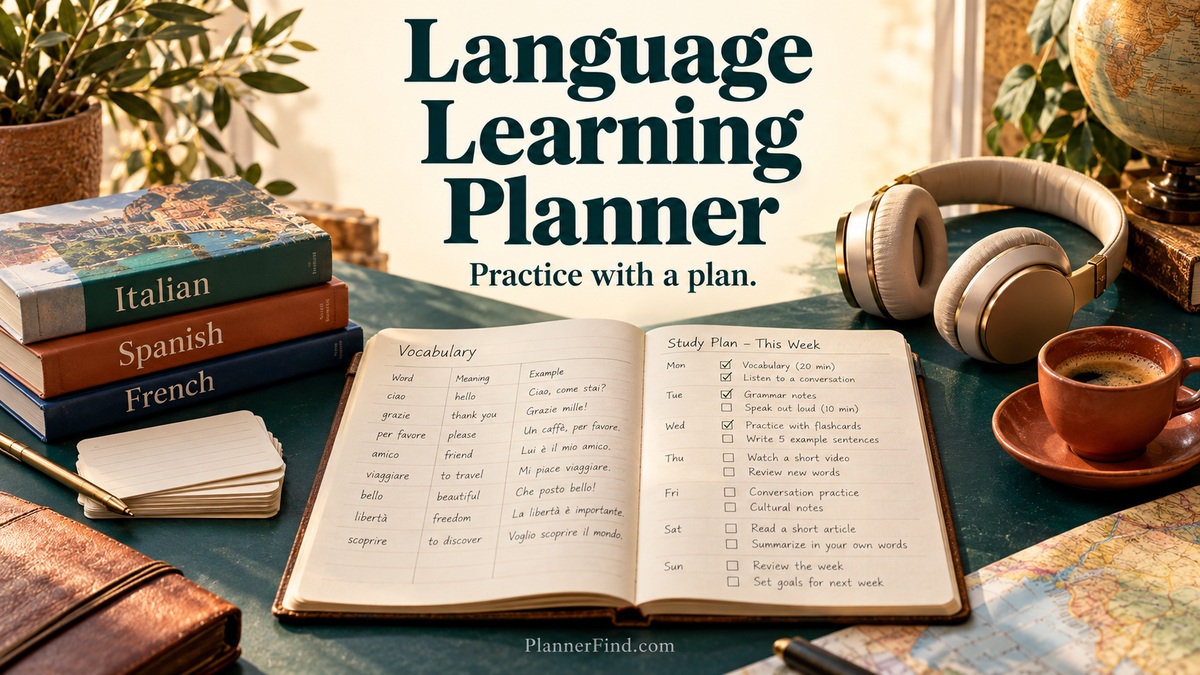
A language learning planner helps you decide what to practice, make time for it, and notice what needs another attempt. Its job is to organize learning from a course, tutor, book, conversation, or app. It does not teach the language simply because its pages include vocabulary or grammar headings.
This selection includes a detailed 13-week journal, editable practice pages, reusable study sheets, vocabulary logbooks, and two specialized options for children’s English development. Those last two serve a narrower audience than adult foreign-language learners, so the reviews make that distinction explicit.
The comparisons use the designers’ Creative Fabrica descriptions rather than assumed app features or downloaded-course testing. Several products are dated 2026; check calendar coverage separately from the reusable practice pages if you are planning for 2027.
In this guide
How to choose a language learning planner
Choose a structure that matches your real study routine. A multi-week journal works well when you want to review progress across several skills. A short daily template is better if a large workbook creates more administration than practice. A vocabulary log is a companion to those routines, not a replacement for listening and speaking.
Check writing space for your language and script. Longer example sentences, accents, or character practice can need more room than a compact word list provides. Paper size and preview layouts matter more than a large headline page count.
Distinguish editable source files from annotation-ready PDFs. Canva links, Illustrator sources, and PPTX files are different tools. A PDF described as Canva-ready may still require importing and checking rather than opening a fully editable template. Do not assume hyperlinks, reminders, or automated review scheduling unless the listing states them.
1. 13-Week Language Learning Journal
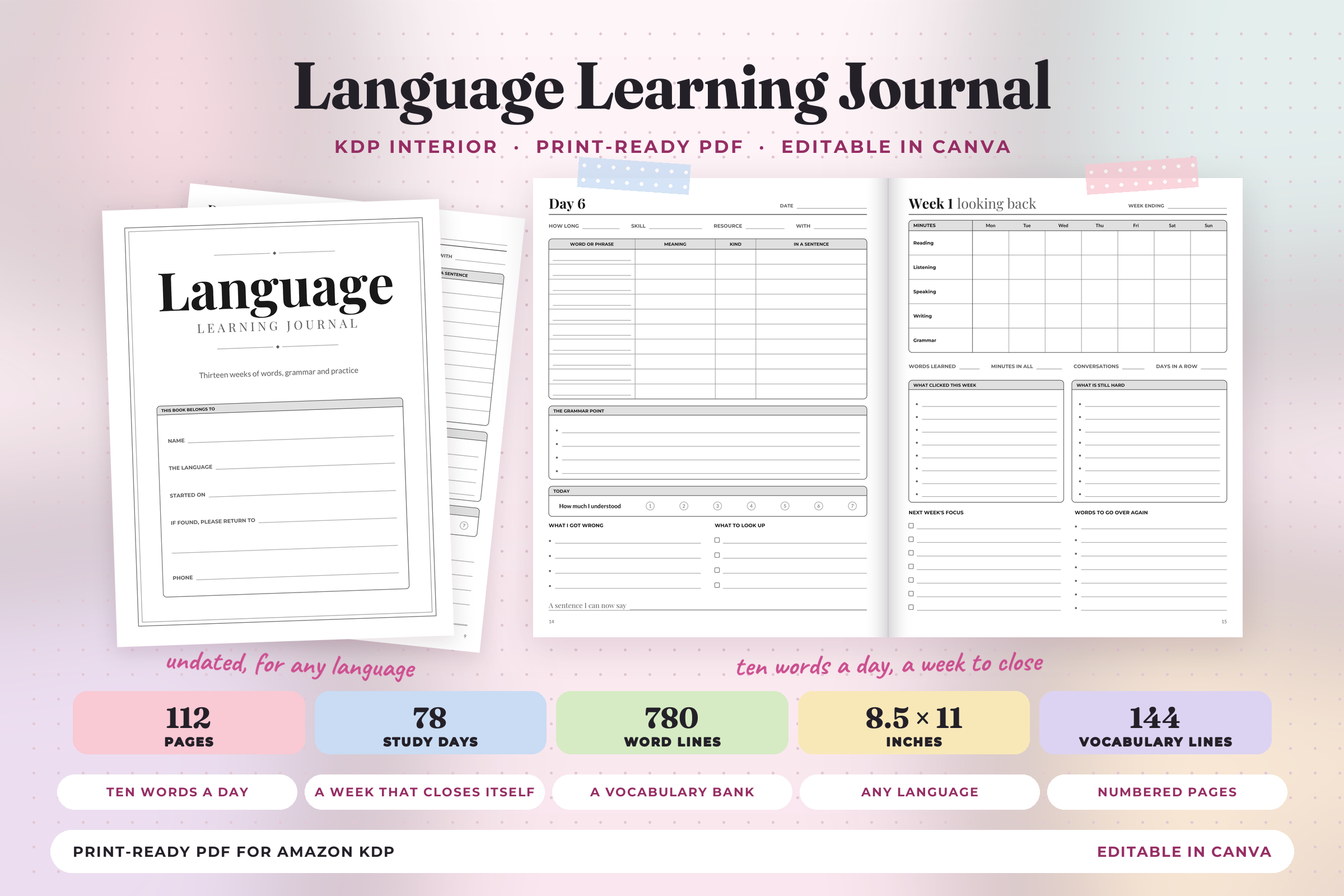
Print Magic StudioX’s Language Learning Journal is the most structured option here for balancing practice across skills. The listing specifies an undated 112-page US Letter PDF, without bleed, plus two Canva-ready PDF parts. It includes starting assessment, resource and goal pages, a weekly routine, daily practice records, vocabulary banks, phrases, conversation notes, mistakes, and weekly statistics.
The 13-week structure contains 78 study-day pages, which means six practice days per week rather than a page for every calendar day. Each daily page offers ten vocabulary rows, giving 780 across the daily section. Use those alongside a short record of listening, speaking, reading, or writing practice so vocabulary collecting does not displace actual language use.
The advantage is detailed tracking over a defined period. The limitation is that this is a journal, not a course or a source of corrected exercises. The seller states that the PDF has no bookmarks or hyperlinks, and Canva-ready PDF parts are not the same as a direct editable Canva template link. Check the small text and print a sample if you prefer generous handwriting space.
2. 2026 Language Practice Progress Tracker
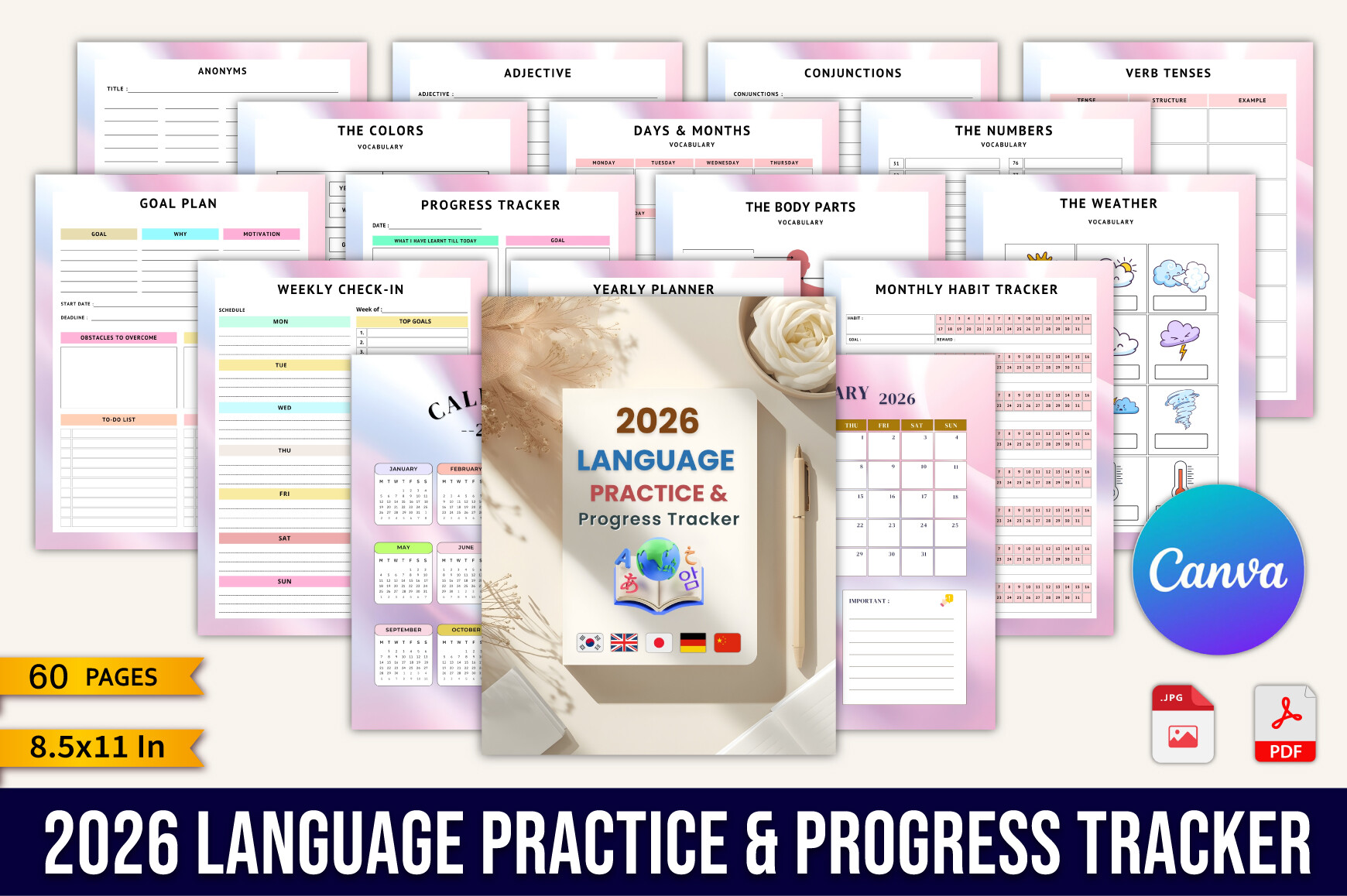
designmela01’s Language Practice Progress Tracker is an editable option with broad practice and review sections. The listing advertises 60 US Letter Canva templates, a PDF, and an editable Canva link. Described areas include daily and weekly planning, vocabulary meanings and translations, example sentences, grammar, phrases, goals, habits, cultural notes, resources, and year-end review.
A useful approach is to set one observable weekly target, such as describing your workday aloud, then plan the listening and vocabulary practice that supports it. Record an example sentence rather than only a translated word. The review sections can help you notice which resources you actually use and which plans need to be made smaller.
The important limitation is the 2026 edition: dated calendar pages are not a 2027 calendar. Reusable practice worksheets may still suit your routine, but inspect the dates before relying on them for future scheduling. Canva editing is helpful for changing labels and writing space; it does not supply lessons, pronunciation feedback, or automatic progress measurement.
3. 2026 Language Learning System
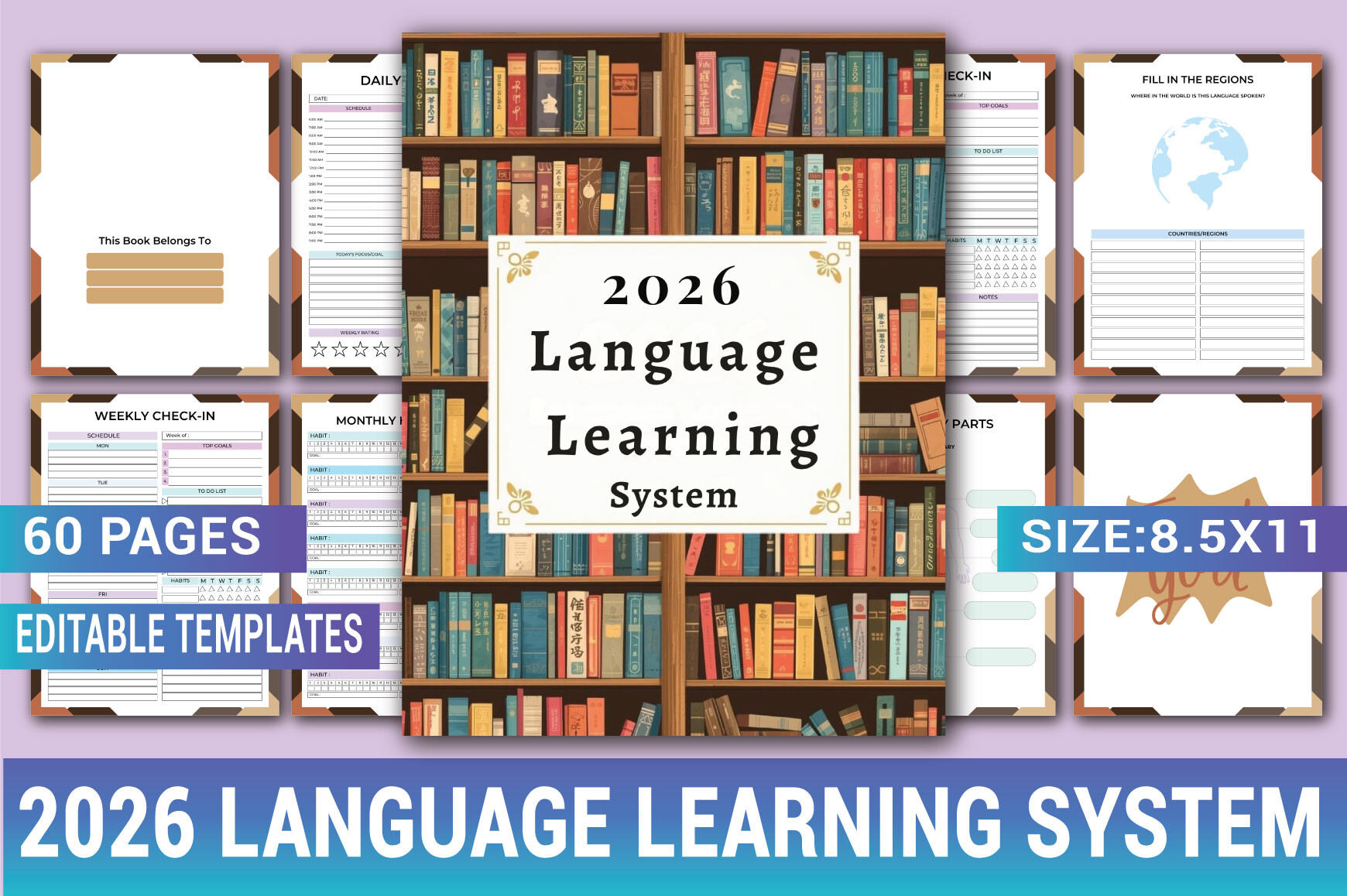
KDPMart’s Language Learning System offers a substantial collection of practice organizers in both US Letter and A4 sizes. The listing specifies 60 templates supplied as PDF, PNG, and JPG files. Described pages cover daily time blocks, weekly goals, habits, monthly and yearly progress, vocabulary topics, grammar, phrases, resources, mistakes, and reflection.
This is a good choice if you want to organize practice by topic and skill. Pick one topic, such as travel, and connect vocabulary notes with a short listening activity and a spoken response. Use the mistakes section to collect recurring problems worth revisiting, rather than rewriting every correction you encounter.
The strength is format and paper-size choice, with more structured topic pages than a plain notebook. The limitation is its 2026 date labeling and the maintenance involved in a large collection. Use only the worksheets that support your current course or tutor. The stated files do not establish an editable Canva link, interactive PDF navigation, or a teaching program; choose it as an organizer for learning you do elsewhere.
4. Bright-Eyed Daily Study and Vocabulary Planner
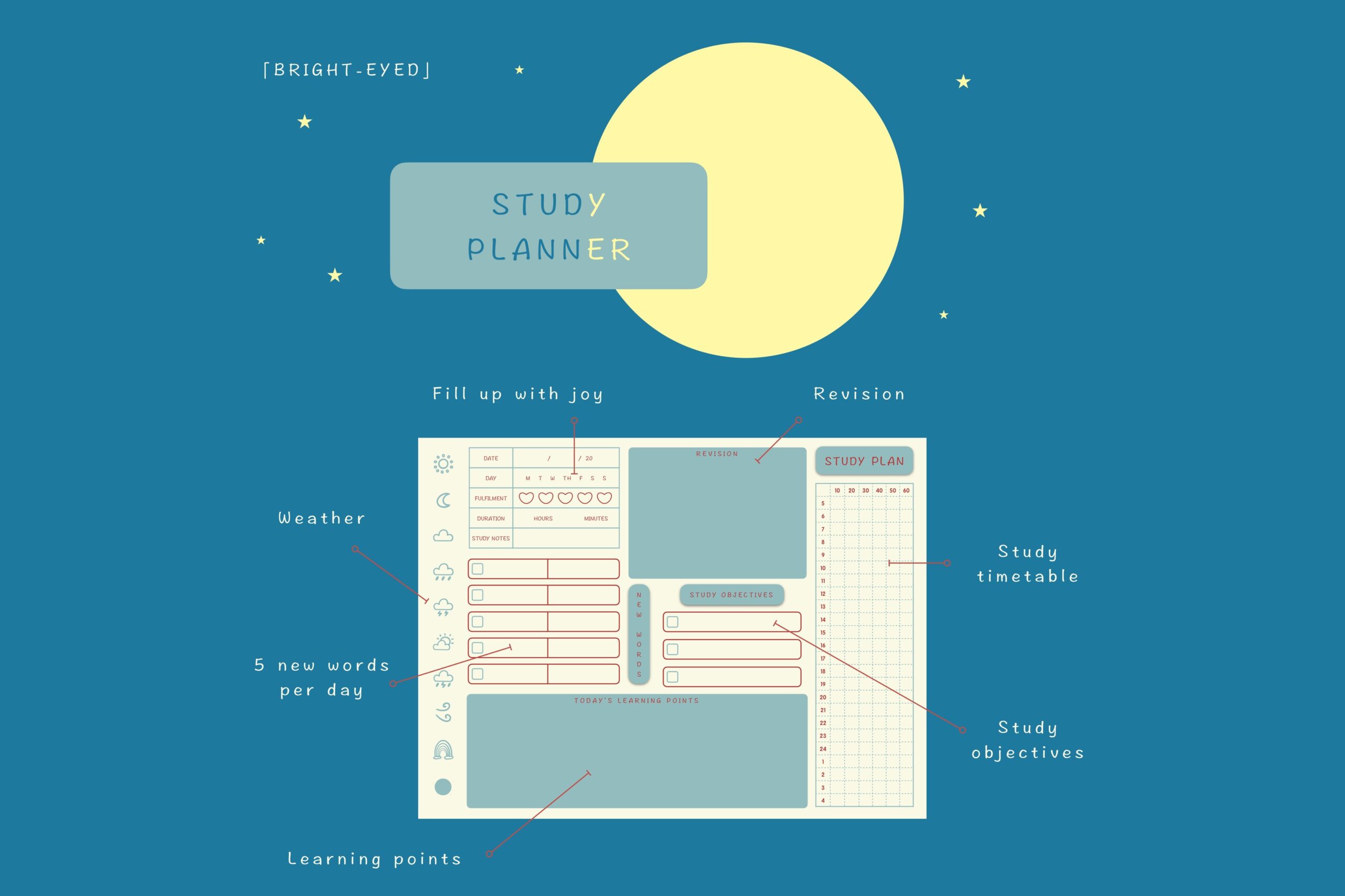
Mogumogu’s Bright-Eyed Study Planner is a lightweight alternative to a large language workbook. The description lists two PDF files: a study planner and a words template. Advertised planning fields include the date, study duration, completion, notes, objectives, a timetable, learning points, and revision. It offers a small repeatable workflow instead of a long fixed program.
Use the study page for one session and the words page for vocabulary you met during that session. Set a specific task before starting, such as listening to one short dialogue and writing a few useful expressions. At the end, record what needs another review. This keeps the planner tied to actual practice instead of an expanding wish list.
The advantage is simplicity, especially for someone who abandons complex trackers. The limitation is that the description does not clearly establish paper size, a complete dated calendar, or interactive features. It is a general study template that can support language practice, rather than a language-specific curriculum. Check the preview for enough space to write translations or examples in your chosen script.
5. Language Study Planner with Editable Source Files
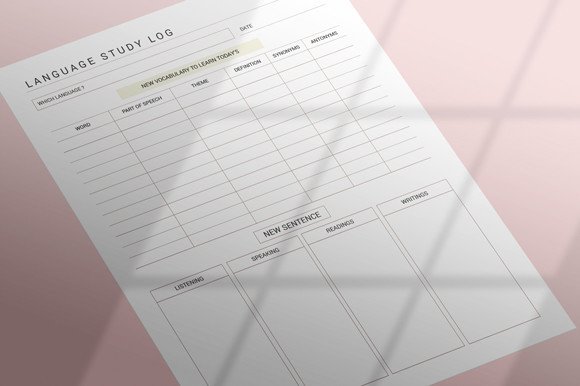
Graphic_hero’s Language Study Planner is a print-oriented package for someone who wants to customize a study interior. The listing identifies 109 US Letter pages, no bleed, 300 PPI, an editable AI source, PDF, JPG, PNG, and PPTX files. Those formats offer more editing options than a PDF-only planner, provided you have suitable software.
Use the preview to decide whether the existing page structure fits the way you record language practice. If you edit the source, keep the routine focused: one task, the resource used, the time spent, and one point to review. Consistent fields make weekly reflection easier than repeatedly changing the layout.
The strength is source-file choice for a user already comfortable with design or presentation tools. The limitation is a sparse inventory of the internal learning fields, so the headline page count cannot establish vocabulary banks, speaking rubrics, or grammar exercises. AI means an Adobe Illustrator file here. The product does not establish artificial-intelligence tutoring, automated correction, or a complete language course.
6. Vocabulary Tracker Log and Study Planner
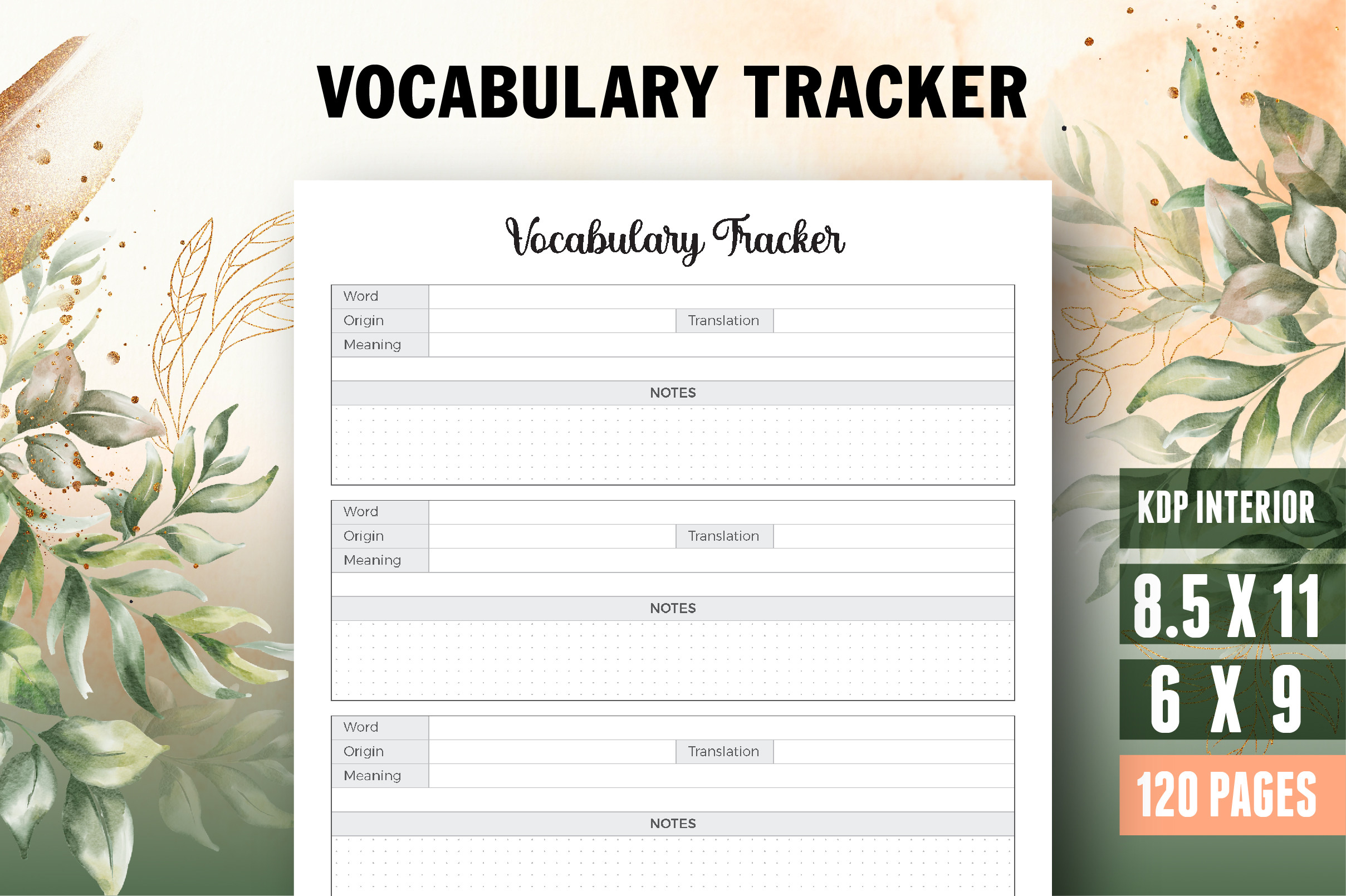
Vector Cafe’s Vocabulary Tracker Log and Study Planner is a dedicated logbook option rather than a full dated language calendar. The advertised package contains a 120-page interior in US Letter and 6 × 9-inch sizes, with PDF, editable AI, and JPEG files, a bleed area, and 300-DPI output. It suits learners who want a separate record of words encountered during other study.
Choose the larger version for longer examples or handwriting practice, and the smaller format for carrying vocabulary notes between lessons. In your own routine, record where a word appeared and return to it in a sentence later. That gives the log a practical purpose beyond collecting translations that you never revisit.
The advantage is format flexibility and a dedicated place for vocabulary. The limitation is that the description does not clearly specify every column or an integrated review schedule. Inspect the preview before expecting spaced-repetition prompts or separate translation fields. The logbook does not teach the words, correct usage, or replace a dictionary, course, tutor, or flashcard system.
7. Vocabulary Learning Tracker for Young English Learners
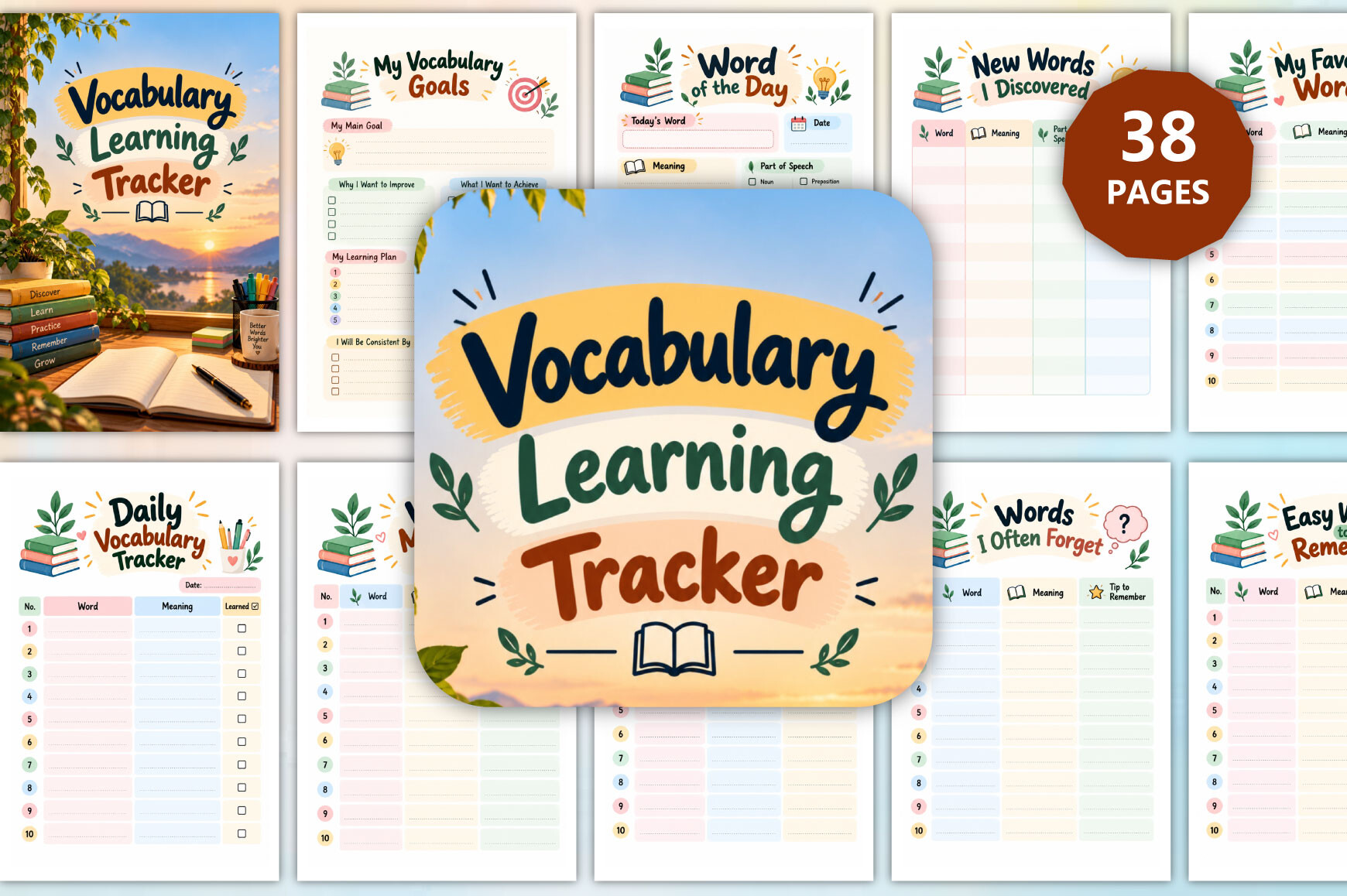
munjixpro’s Vocabulary Learning Tracker is a more guided option for children building English vocabulary. The listing specifies 38 pages in 6 × 9-inch PDF and JPG formats, no bleed, and 300 DPI. Described sections include word goals, meanings, parts of speech, examples, synonyms, antonyms, spelling, pronunciation practice, word families, weekly review, and progress.
Use a small set of words from something the child has read or heard, then connect each word with a meaningful example. A parent or teacher can use the weekly review page to decide what needs another explanation. Keep the workload short enough that writing in the tracker supports reading and conversation instead of crowding them out.
The strength is more scaffolding than a blank vocabulary log. The limitation is its audience and scope: it is described for children’s English development, not as a multilingual adult study system. Do not expect a ready-made translation curriculum or automatic pronunciation feedback. It is the better fit when an adult can guide practice and check the examples.
8. Language Arts Planner for Children’s English Practice
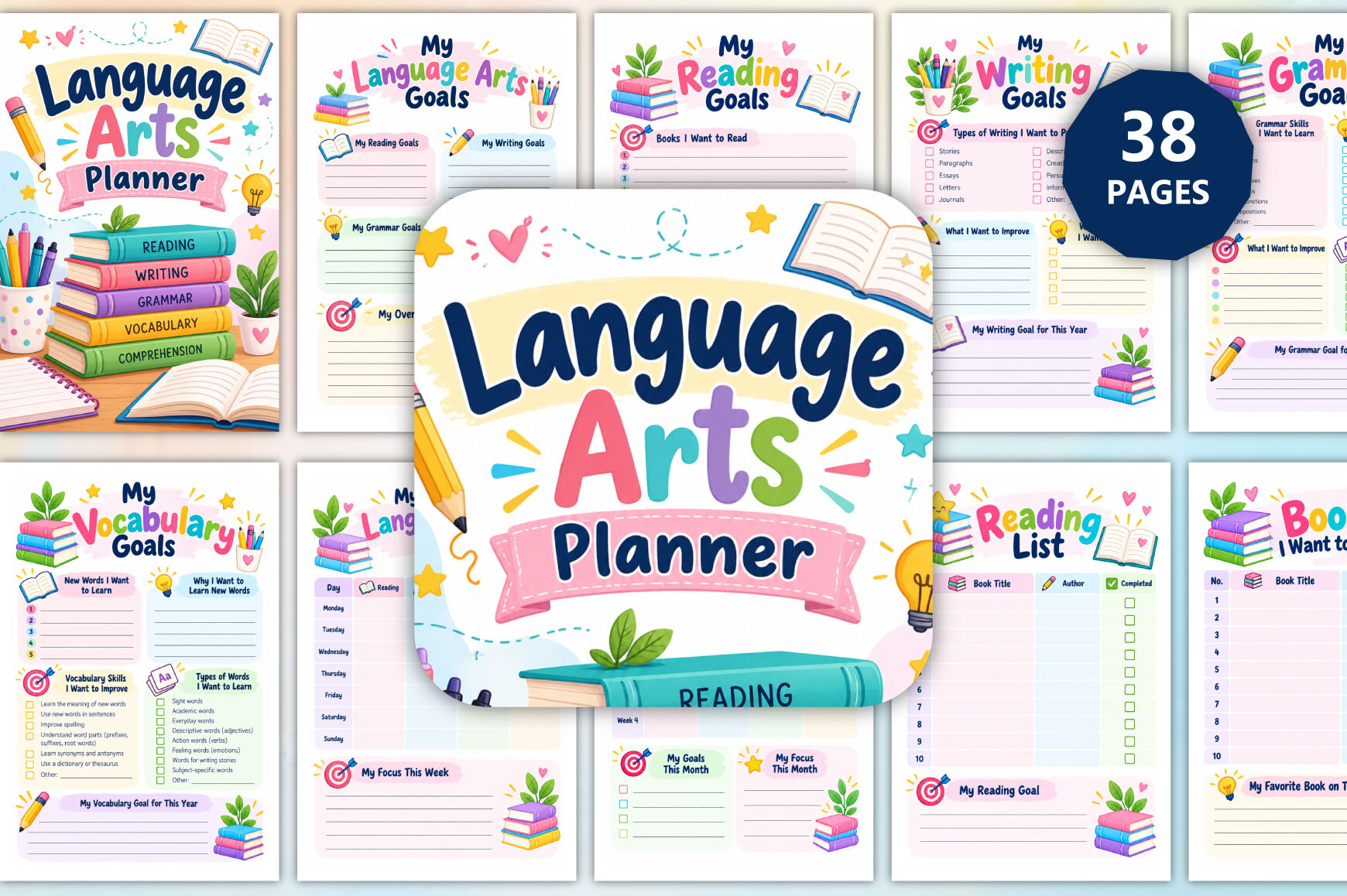
munjixpro’s Language Arts Planner is a specialized companion for children practicing English reading and writing. The listing identifies 38 pages, 6 × 9 inches, PDF and JPG files, no bleed, and 300 DPI. Advertised sections cover reading lists, vocabulary, spelling, grammar, comprehension, story and paragraph writing, weekly and monthly goals, quizzes, and review.
Consider it when language learning means strengthening a child’s English literacy. Link the plan to a real book or lesson: read a short passage, discuss it, then choose one writing or vocabulary activity. An adult can use the review pages to keep a record of what was practiced and what should be explained again.
The limitation is crucial: language arts is not the same as an adult foreign-language planner. This will not organize a complete French or Spanish course, and it does not establish bilingual teaching materials or ready-made answers. Its value is organizing supervised English practice across several skills. For independent multilingual study, the 13-week journal or a vocabulary log above is the more appropriate starting point.
Plan one week around a useful language task
Choose something you want to do with the language, such as introducing yourself, ordering a meal, or explaining a work problem. Plan a short listening or reading activity, collect useful expressions, and then use them in speaking or writing. This gives vocabulary notes a purpose.
Record what you completed and one thing to revisit. If a week repeatedly goes unfinished, reduce the plan before buying a more complicated organizer. A ten-minute session you can repeat is easier to review than an ambitious timetable you rarely follow.
Make vocabulary notes useful after the first session
Write a phrase or example alongside a new word whenever your layout allows. Include a source or context in your own notes so you can check meaning again. A short list you return to is more useful than a large collection with no review habit.
Use your existing course or teacher to check correctness. Planner pages are records, and a progress box is not a proficiency assessment. For broader class commitments, keep deadlines in a separate academic planner and leave the language pages focused on practice.
Which language learning planner should you start with?
Start with the 13-week journal if you want detailed skill tracking without dated calendars. Choose the editable progress tracker if changing headings matters, while remembering its 2026 date coverage. The two-page Bright-Eyed set is the simplest option for a daily study-and-words routine.
For children practicing English, the vocabulary and language-arts planners offer more guided categories with adult support. For adult multilingual study, choose the journal or logbook instead. Pick one core planner, try it for two weeks, and add specialist pages only when they solve a problem you have actually encountered.