11 Monthly Budget Planner Options to Take Control of Your Money
A monthly budget planner can be surprisingly powerful when it turns vague financial goals into something you can actually see and manage. Instead of wondering where your paycheck went, you can give every dollar a purpose, monitor recurring expenses, and check whether your spending is moving you toward the goals that matter.
For this collection, I looked at these planners from a slightly different angle: how much financial control do they give you? Some are deliberately simple, with just enough space to plan income and expenses. Others behave more like complete financial dashboards, adding savings goals, debt tracking, subscriptions, charts, and even net worth tracking.
That makes the choice less about finding the “best” budget planner and more about finding the right level of financial organization for your life.
1. Monthly Budget Planner Google Sheet — Best for Automated Budgeting
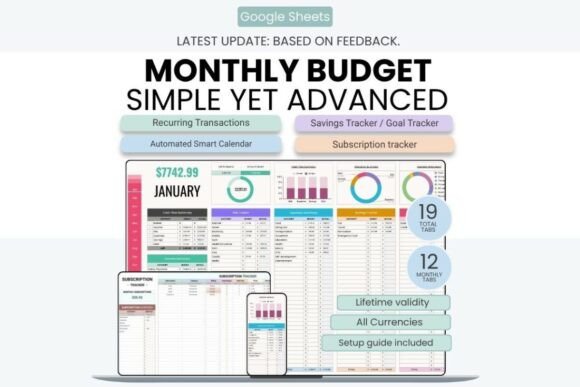
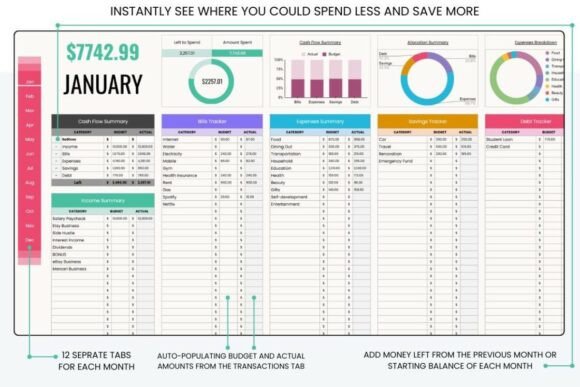
If you want your budget to do some of the mathematical work for you, this is one of the strongest options in the collection.
The Google Sheets template contains 19 organized tabs, monthly dashboards, income and expense tracking, budget-versus-actual comparisons, a transaction log, sinking funds, savings goals, subscriptions, recurring transactions, and an automated calendar for scheduled transactions. It also provides annual financial summaries and automatic calculations and reports.
I especially like the distinction between simply recording what you spent and actually comparing planned spending with reality. That turns a monthly budget into something you can review and adjust instead of a document you fill in once and forget.
It is designed specifically for Google Sheets and can be accessed from computers, tablets, and smartphones, with data synchronized across devices.
For someone who wants a serious digital budgeting system without manually building formulas from scratch, I’d put this near the top of the list.
2. Monthly Budget Planner Dark Version — For a Sleek Financial Dashboard
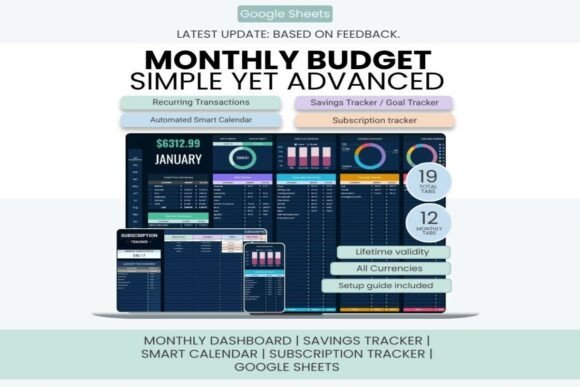
Budgeting can be a lot more pleasant when the interface doesn’t look like a boring accounting document. This dark-themed option is aimed at people who prefer a modern, distraction-free financial workspace.
The planner is part of a broader dark-theme finance system and is designed for both Excel and Google Sheets. The monthly budget component covers income, expenses, and savings goals, with smart visuals and automated summaries.
What makes this one interesting is the visual approach. The darker interface isn’t just decorative; it gives the spreadsheet a completely different feel from traditional bright financial templates.
The larger bundle also includes tools for debt, bills, Airbnb income and expenses, and rental-property finances, so it makes particular sense if you want your monthly budget to sit inside a broader financial system.
I’d choose this one for someone who wants spreadsheet functionality with a more polished, modern aesthetic.
3. Monthly Budget Planner Finance Sheet — A Straightforward Budgeting Option
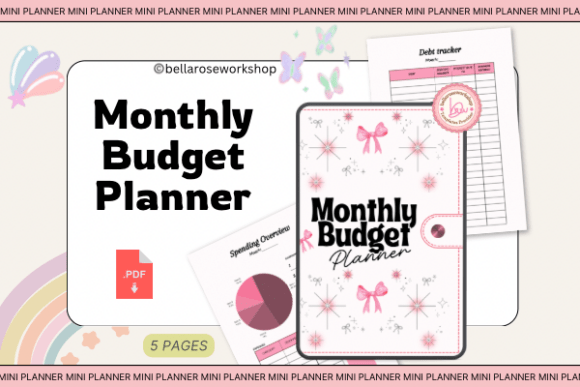
Not everyone needs an elaborate financial dashboard. Sometimes the most useful monthly budget planner is simply the one that makes income and spending easier to understand.
This option is worth considering if you prefer a more traditional finance-sheet approach. Its focus is the monthly budgeting process rather than turning your finances into a massive all-in-one management system.
That distinction is important when choosing a planner. If you already have a separate system for savings, investments, or debt, adding dozens of additional financial trackers may actually make your routine harder to maintain.
I’d place this type of planner in the focused budgeting category: useful for people who primarily want to plan their monthly money and keep spending organized without building an entire personal-finance database.
4. Monthly Budget Planner — A Traditional Monthly Planning Format
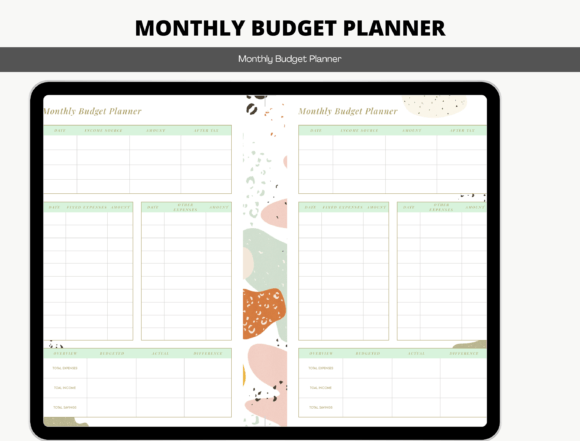
This is another option for anyone who wants the concept of a monthly budget kept front and center.
Rather than choosing a financial toolkit with numerous specialized trackers, a dedicated monthly budget planner can be easier to understand at a glance. You can make your financial planning revolve around the month itself — what comes in, what needs to go out, and how much room remains for your priorities.
I’d consider this kind of format particularly useful if you’re new to budgeting and don’t want to start with an intimidating financial system.
There’s a useful principle here that applies to almost every budget planner: complexity isn’t automatically a benefit. A simple system that you update consistently is much more valuable than an advanced one that you abandon after two weeks.
5. Financial Management Spreadsheets — For a Bigger Financial Picture
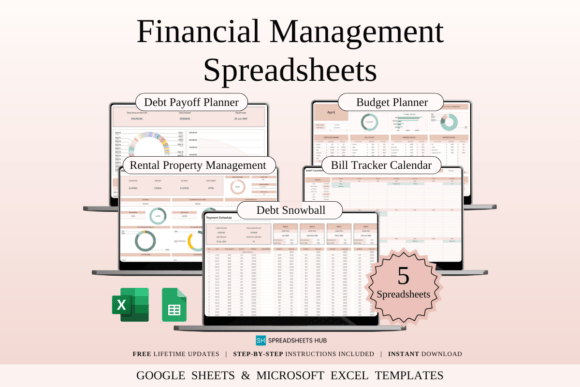
If monthly budgeting is only one part of what you want to organize, a broader financial-management spreadsheet may make more sense.
This type of resource moves beyond the narrow question of “How much can I spend this month?” and toward the bigger picture of managing your finances systematically.
I’d look at this category if you want your monthly budget to connect with other financial information rather than existing on its own.
That can be particularly helpful once your financial situation becomes more complicated. Multiple income sources, savings targets, recurring expenses, and longer-term goals can make a basic monthly worksheet feel limiting.
The important thing is to avoid adding complexity just because you can. If your financial needs are still straightforward, one of the dedicated monthly planners above may be a better starting point.
6. Financial Tools Excel & Google Sheets — A Multi-Purpose Finance Bundle
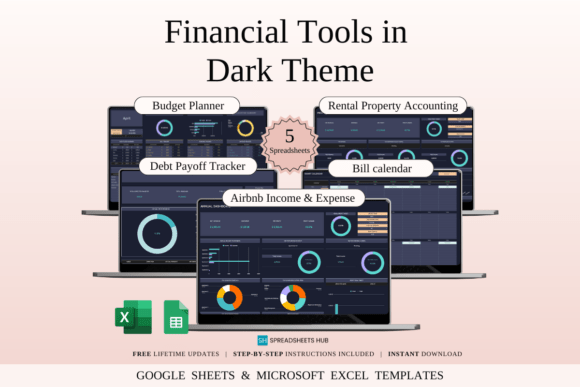
This one takes a different approach by putting several financial tools into one package.
The bundle includes 20 spreadsheet templates, with sample and blank versions for both Google Sheets and Excel. Among the tools are a debt tracker, monthly bill calendar, Airbnb income and expense tracker, rental property finance tracker, and a dark-mode monthly budget planner.
That makes it particularly useful for people whose finances don’t fit neatly into a single personal-budget spreadsheet.
The compatibility with both Excel and Google Sheets is another advantage. You aren’t locked into one spreadsheet ecosystem, although the listing recommends a desktop or laptop for the best editing experience.
For me, this is less of a “monthly budget planner” and more of a financial toolkit that happens to include one. I’d choose it if you expect to use several financial trackers rather than only needing a monthly spending plan.
7. Monthly Finance Planner Template — For Goals, Bills, and Savings
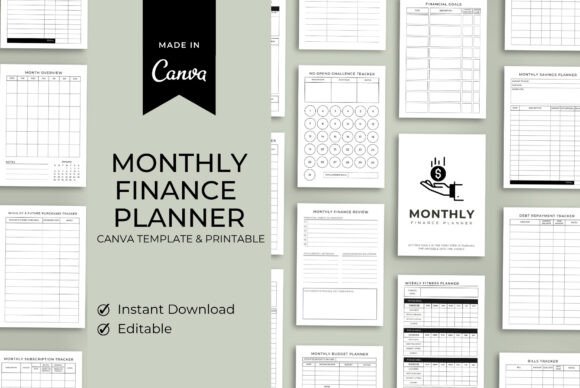
This Canva-based template takes a more visual and customizable approach to financial organization.
The listed sections include a budget planner, monthly review, finance summary, financial goals, savings, debt repayment, bills, wishlist and future purchases, subscriptions, and a monthly budget planner.
I like the fact that the structure isn’t limited to recording expenses. The inclusion of financial goals and monthly reviews encourages you to look backward and forward at the same time: what happened this month, and what do you want to accomplish next?
Because it’s designed in Canva, you can also customize the visual presentation, including colors, fonts, and layouts.
I’d choose this one if you prefer your budgeting tools to feel more like a personal finance journal than a conventional spreadsheet.
8. Ultimate Personal Finance Toolkit — For Long-Term Financial Organization
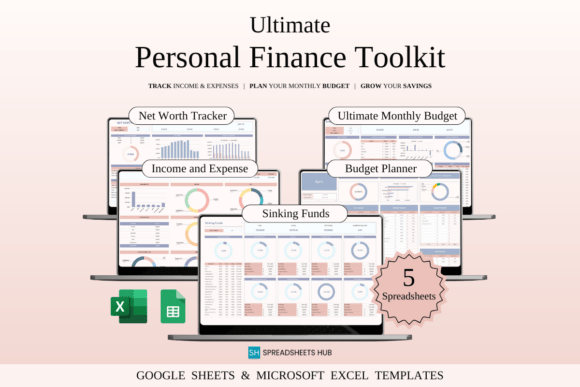
This is the option I’d investigate if your goal goes well beyond getting through the current month.
The toolkit contains five spreadsheets: an Ultimate Monthly Budget Spreadsheet, Net Worth Tracker, Sinking Funds Tracker, Budget Planner/Monthly Finance Tracker, and Income and Expense Tracker. The templates are designed for both Excel and Google Sheets.
That combination gives it a different purpose from a standalone monthly budget. You can use the monthly budget to manage immediate cash flow while also tracking things such as net worth and sinking funds over a longer period.
Built-in formulas, dashboards, charts, and sections for fixed and variable expenses, savings, and debt are also included.
For someone who is trying to build long-term financial habits, I think this is considerably more interesting than simply tracking expenses. You’re not only asking where your money went; you’re creating a broader picture of your financial progress.
9. Monthly Expenses Tracker Budget Planner — For Spending Awareness
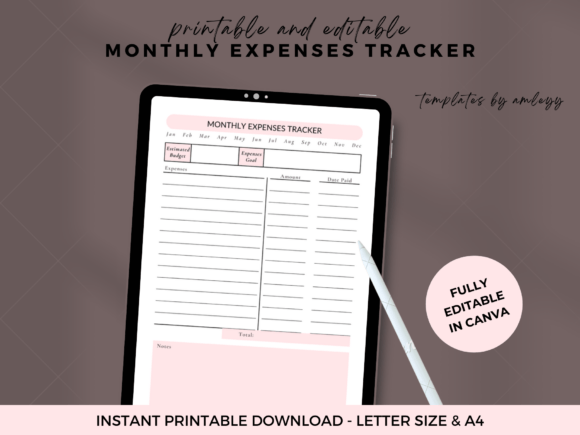
This one takes a deliberately focused approach to spending.
The Canva template is designed around recording the date, expense description, category, amount spent, and payment method. It has a clean, minimalist design and can be customized in Canva, including colors, fonts, and layout. It can also be used digitally or printed.
For me, this is an excellent example of why an expense tracker and a full budget planner aren’t necessarily the same thing.
If your biggest financial problem is simply not knowing where your money disappears, starting with a straightforward spending log can be more useful than jumping directly into a complex financial dashboard.
I’d recommend this style to beginners or anyone who wants maximum simplicity. You can focus on developing the habit of recording purchases first and add more sophisticated budgeting later.
10. 💰 Monthly Finance Tracker – Budget Plan — A Balanced All-Rounder
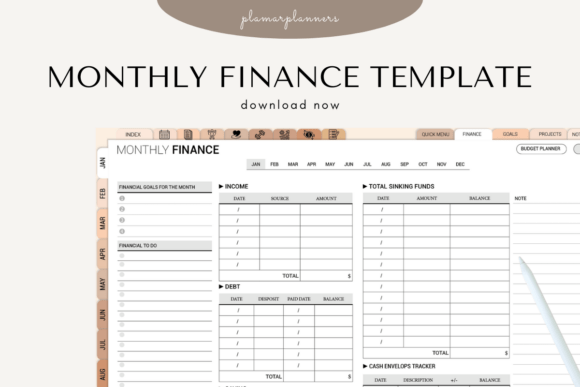
This option sits nicely between a basic expense log and a full financial-management toolkit.
It includes a monthly budget overview, income log, expense tracker, fixed-versus-variable cost breakdown, savings goals, monthly financial summary, debt payment log, and notes section. It’s supplied in A4 and US Letter PDF formats and has a digital version optimized for tablet use.
I particularly like the fixed vs. variable expense breakdown. It gives you a more useful view of your spending than simply adding up every purchase, because recurring obligations and flexible spending behave very differently in a monthly budget.
The planner is also positioned for individuals, families, students, and small businesses, so it isn’t tied to one specific type of financial situation.
If you want a balanced combination of income, spending, savings, and debt tracking without moving into a giant spreadsheet system, this is one of the more sensible choices.
11. Monthly Budget Google Sheets — For Visual Budget Tracking
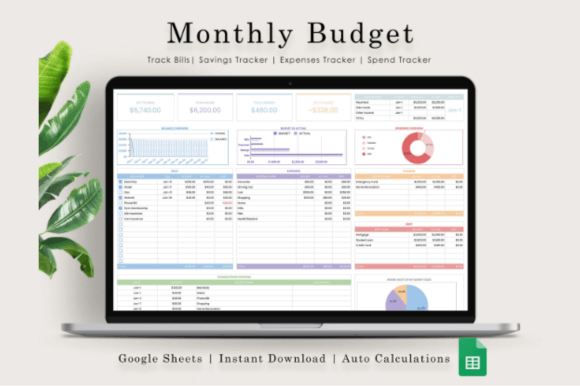
Google Sheets is particularly useful for budgeting because it combines accessibility with the ability to automate calculations and visualize information.
This template includes a monthly and annual budget spreadsheet, a dashboard with charts and graphs, and a transactions tracker organized by categories such as shopping, food, utilities, and groceries.
That dashboard element is what separates it from a simple list of expenses. Seeing financial information visually can make patterns much easier to notice — especially if you tend to understand numbers better when they’re represented through charts.
You’ll need a free Google account to use it, and the product is a digital download rather than a physical planner.
I’d choose this one if you want Google Sheets specifically and prefer seeing your monthly finances summarized visually instead of working exclusively from rows of transactions.
Which Monthly Budget Planner Is Right for You?
The easiest way to narrow these options down is to start with how you prefer to budget, rather than how many features each product has.
If you want a simple spending tracker, the Monthly Expenses Tracker is probably enough. Its minimalist Canva format keeps the emphasis on recording what you spend. (Creative Fabrica)
For a more complete but still understandable system, the 💰 Monthly Finance Tracker adds income, expenses, savings, debt, and financial summaries.
If you’re comfortable with spreadsheets and want automation, I’d focus on the Google Sheets options. The newer Monthly Budget Planner Google Sheet includes automated calculations, dashboards, recurring transactions, sinking funds, subscriptions, and annual reporting.
For people who want Excel and Google Sheets compatibility, the Financial Tools bundle and Ultimate Personal Finance Toolkit offer a much broader collection of financial spreadsheets.
And if you’re trying to make budgeting part of a larger financial strategy, the Ultimate Personal Finance Toolkit is the most compelling choice because it connects monthly budgeting with net worth, sinking funds, and income/expense tracking.
One final distinction I’d pay attention to is planning versus tracking. A budget planner helps you decide what should happen with your money. An expense tracker tells you what actually happened. The best systems bring both together so you can compare your plan with reality and adjust the following month.
You may also like:
5 Comfortable Printable Budget Planner Templates to Organize Your Money
9 Best Digital Budget Planner Templates to Organize Your Money and Spending